Sulphur Springs 2026: Storylines to watch for
May 8, 2026
The 2026 Sulphur Springs Trail Race is right around the corner and there a few storylines I’m following.
- The men’s 50k may be the most competitive of all time.
- The women’s 100K and 100M records are under serious threat.
- A trail newcomer is poised to reset what is possible in the men’s 100M.
- A team competition?
I’ve got a sneak peak of the start list and I’ve done the best I can to add more information to it, like incorporating UTMB and ITRA indexes, and past results to get a sense of how these races are going to play out. By combining historical finishing data, geospatial modeling, and UTMB/ITRA performance indices, we can map out not just who’s racing—but how these races are likely to unfold. My hope is to build some excitement for the races, and provide at least for myself, some idea of the main storylines to follow throughout the event.
Field Depth & Competitiveness
How strong is this year’s field?
To find out, I looked up the UTMB Performance Index of every entrant and then plotted the average of the Top 3 entrants in 2026 against the average index of the Top 3 finishers from every year dating back to 2010. By focusing on the top-end of the field, we can see the true competitive ceiling of the race.
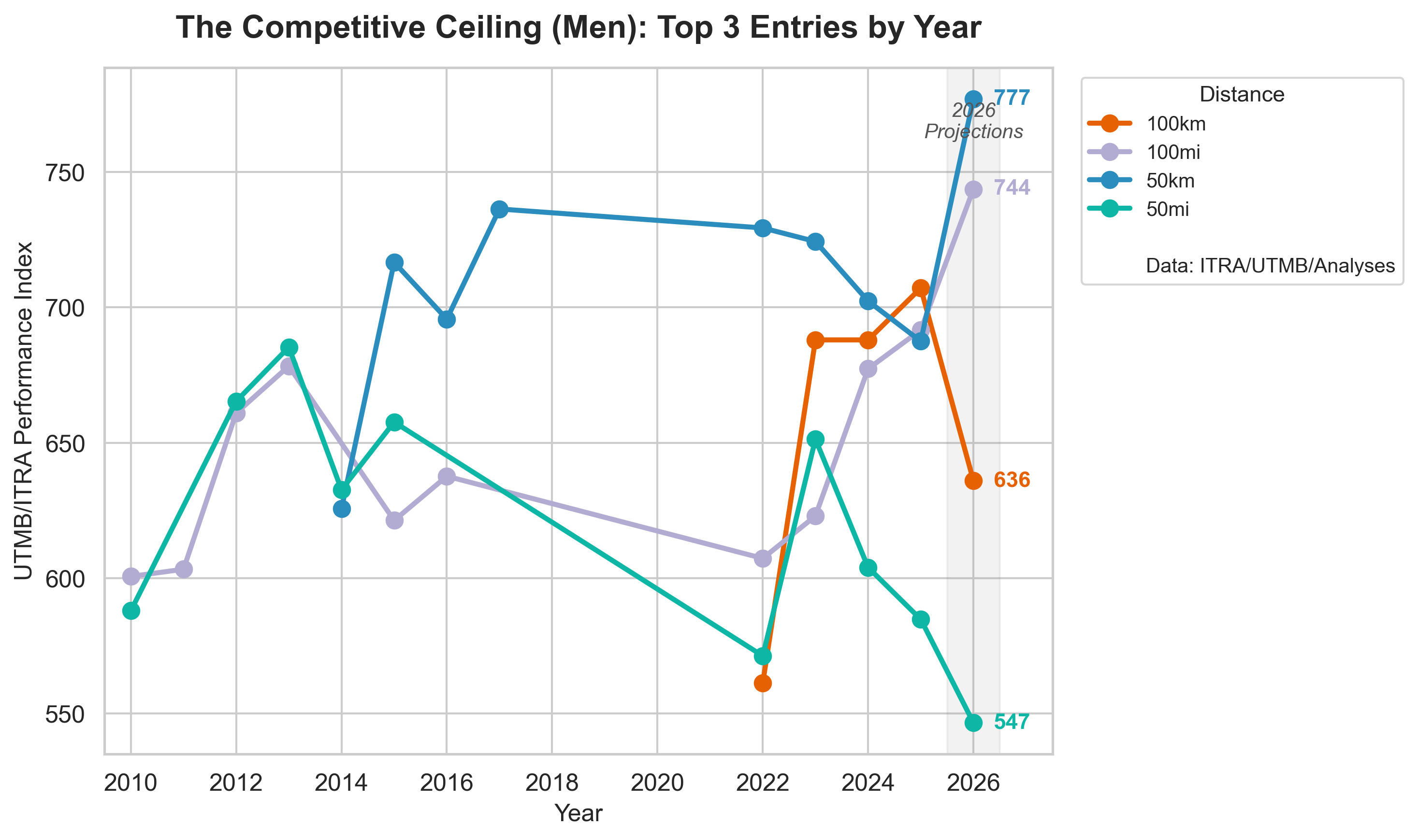
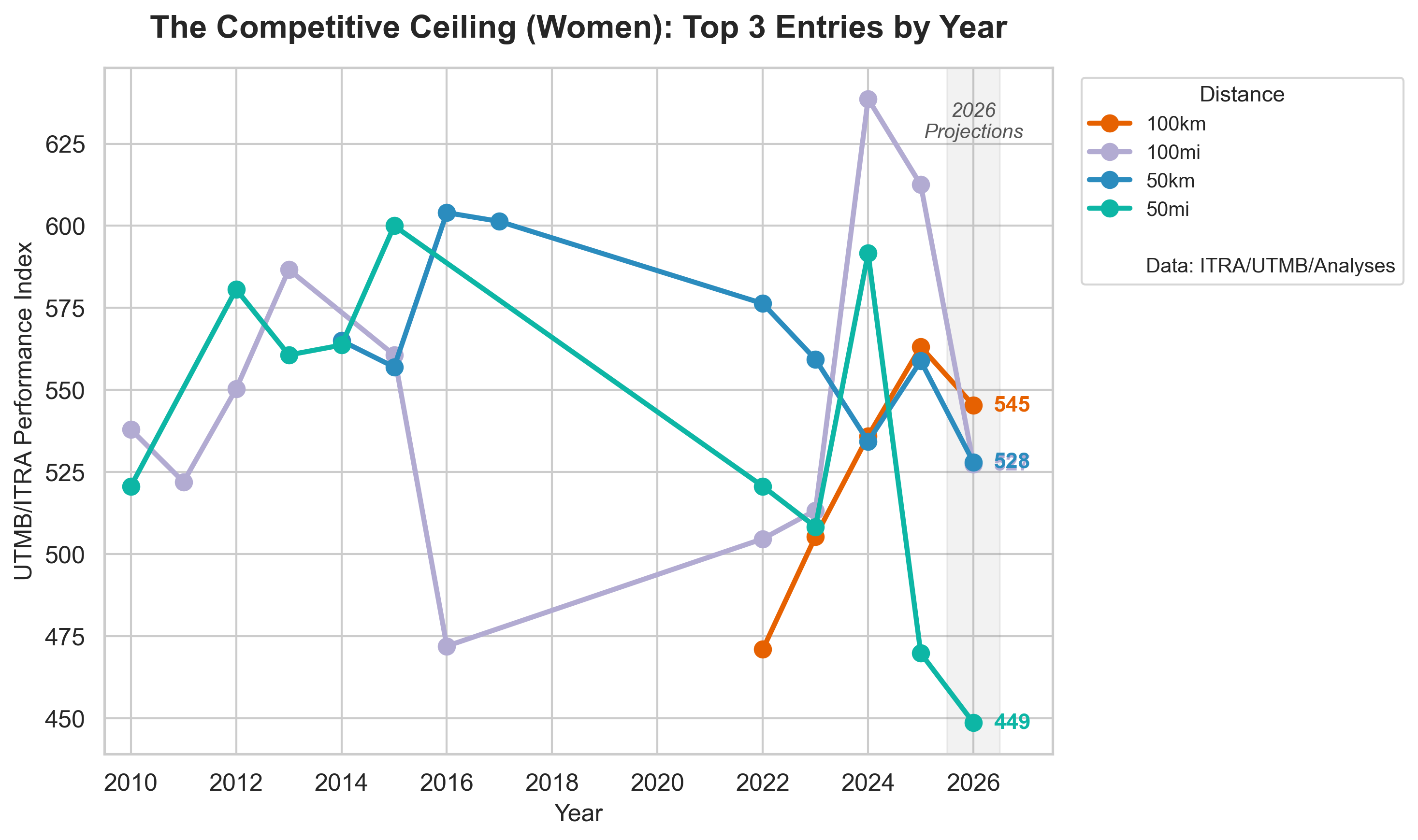
The Men’s 50k stands out as the marquee race this weekend. The average index of the top 3 male entrants (~777) is higher than any winning trio in the event’s 30-year history. The men’s 100M is the only other event with an increase in the entrance index, which is due to an outlier we’ll discuss later. The other events all are projecting lower values than last year. As with the rest of this analysis, it’s worth noting that these are projections. UTMB index is not a perfect measure of competition, and there are likely runners that I’m missing from this dataset. That said, my goal isn’t to make a perfect prediction, but rather to provide a story of the 2026 race based on the data available to me.
At the full-field level, the races blend together. But isolating the projected top 10 reveals very different competitive structures across distances.
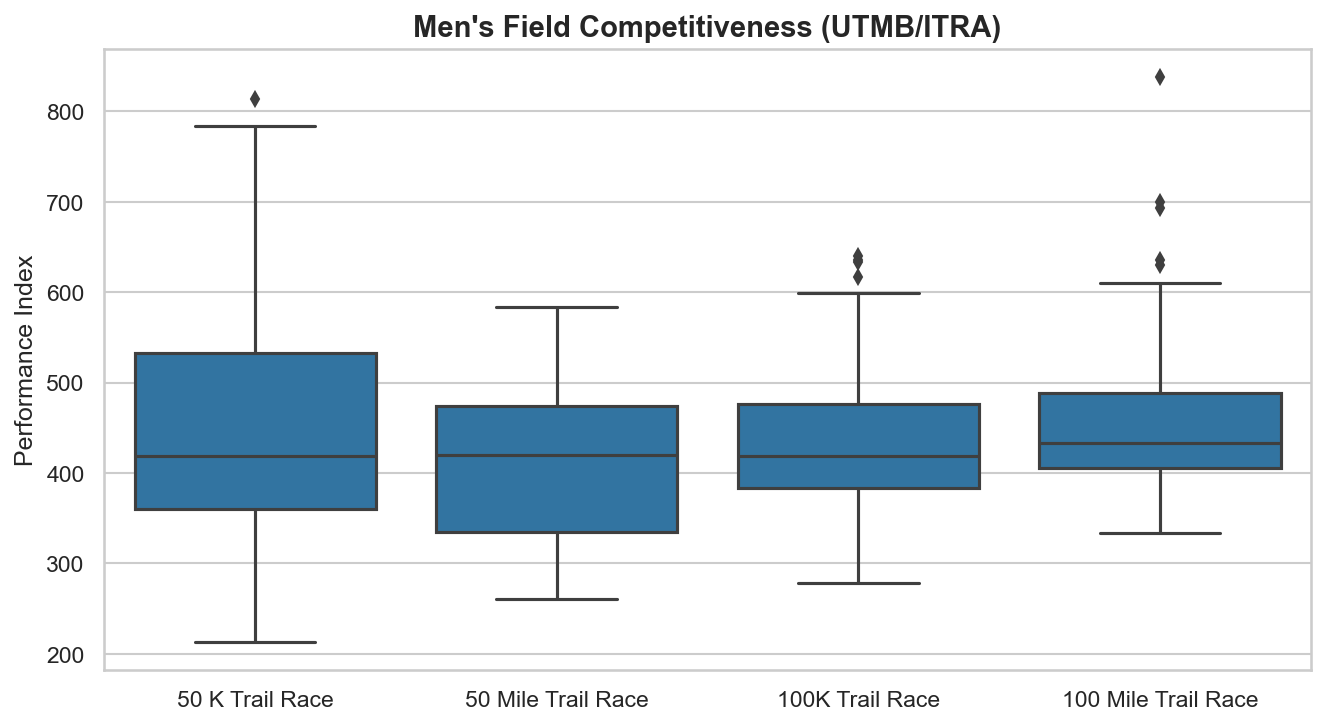
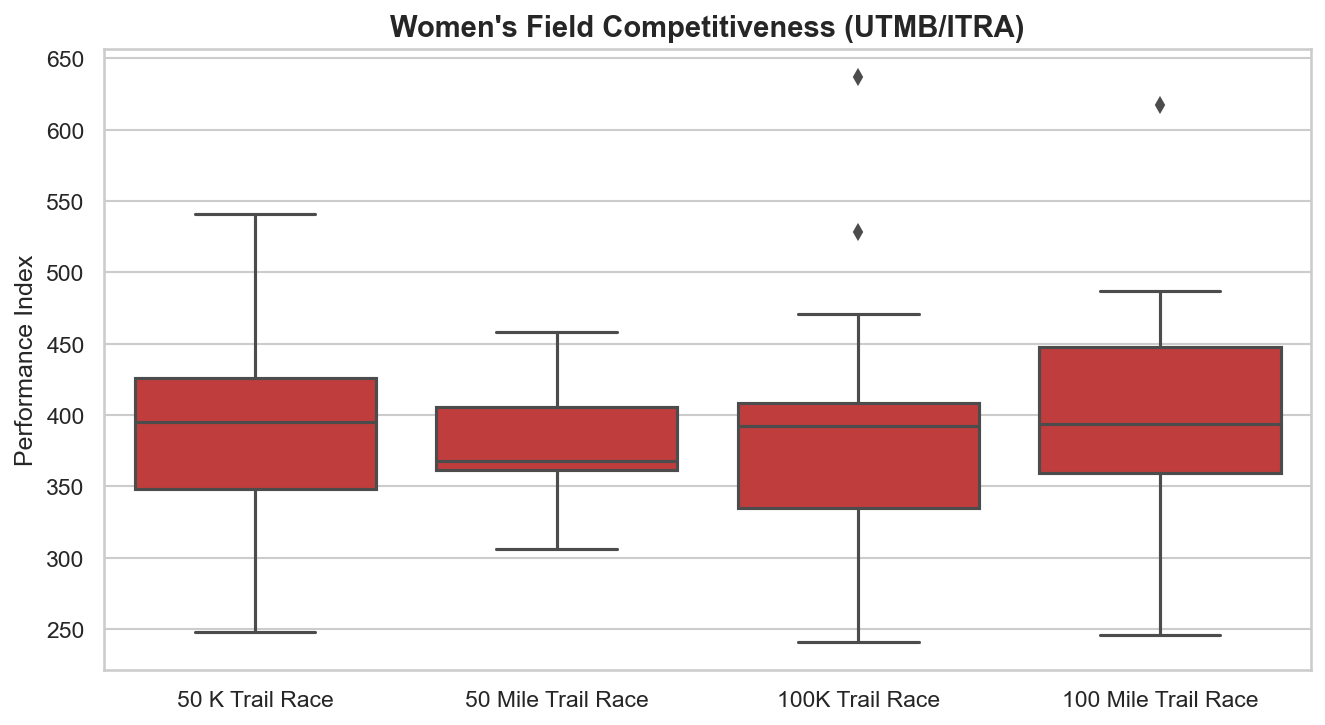
Filtering to just the projected top 10, and the picture sharpens.
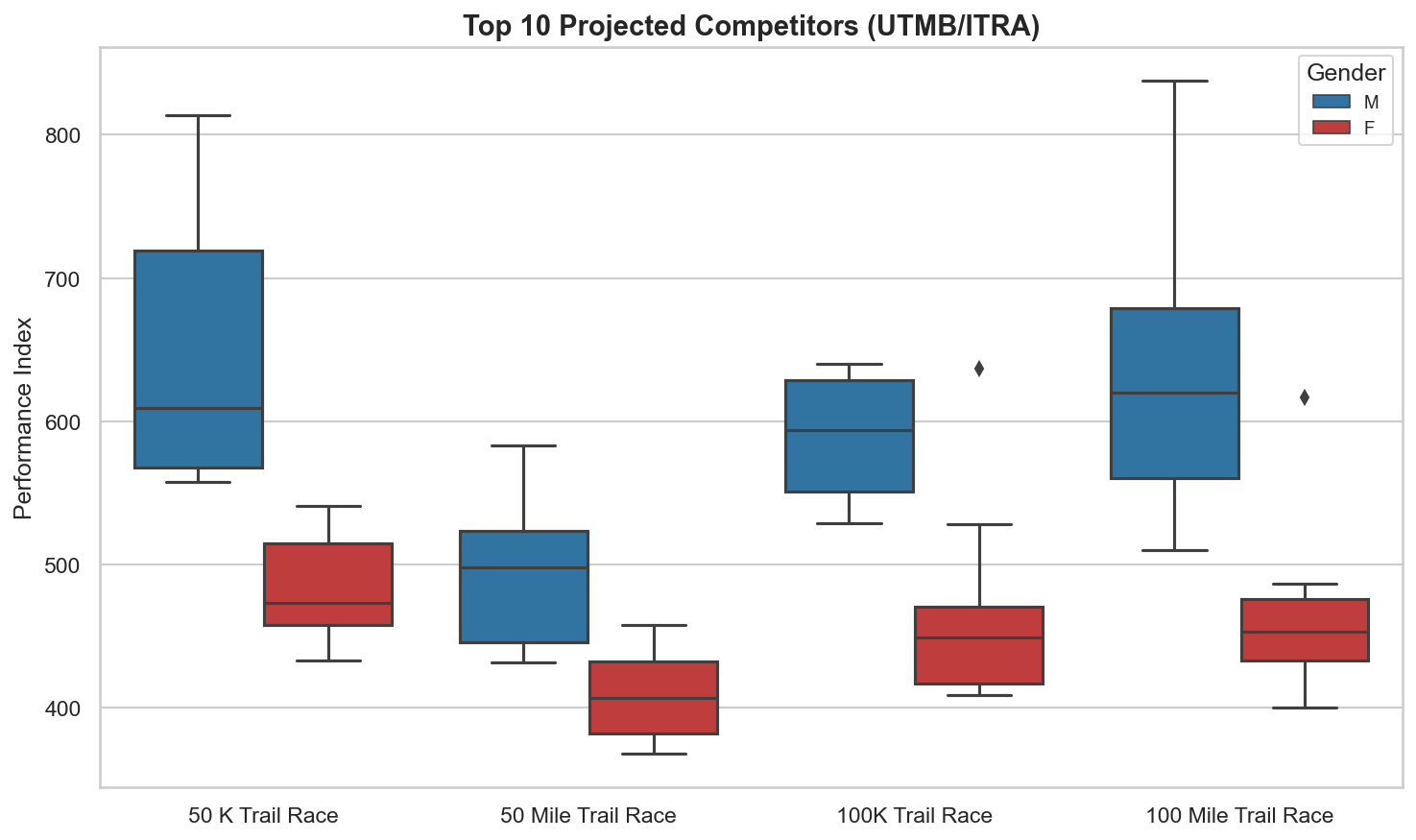
- The Men’s 50k and 100M have the highest ceilings of all the races, but a high spread in the top 10, while the 50M and 100k are more compressed, hinting at tighter race for these spots.
- The Women’s 50k dominates, and somehow the 100k and 100M still have outliers, indicating how above and beyond the top women are in each of these races.
The Men’s 50k Battle
The Men’s 50k field is arguably the most competitive and densely packed race of the weekend. A closer look at the entrants reveals what is essentially a rematch of 2023, except nearly everyone has levelled up since then.
| Athlete | UTMB Index | Half Marathon PB | Sulphur Podiums / Finishes | Sulphur 50k PB |
|---|---|---|---|---|
| Dylan Pust | 814 | 1:11:32 | 2 / 2 | 3:37:32 |
| Matthew Farquharson | 784 | 1:10:54 | 3 / 3 | 3:43:32 |
| Jeremy Walsh | 733 | 1:13:11 | 2 / 4 | 4:05:18 |
- Dylan Pust — The favourite on paper with an 814 UTMB index. Dylan has the engine of a former elite triathlete, which translates to serious speed on the trails. He won the Sulphur Springs 50k in 2023 in a blistering 3:37:32, and then stepped up to the 100K in 2024 to take 2nd place in 8:29:04. Earlier this year he was 9th at the very competitive Black Canyons 50k in 3:34:02 which gave him a UTMB race score of 840. He comes into the race fresh and ready to maintain his Sulphur podium streak.
- Matthew Farquharson — Coming in with a 784 index, Matt is a true Sulphur Springs veteran. He has been incredibly consistent at the 50k distance here: he won the race in 2019 (3:43:32), and was 2nd in both 2018 (3:48:00) and 2023 (3:46:05), the latter putting him directly behind Dylan who he hung onto for the first 30k. He finished 10th place at the historic JFK 50 Mile in late 2025 (5:53:35), he is primed for another podium battle.
- Jeremy Walsh — Returning after winning the 20k last year in the second fastest time in the race’s history (1:18:14). His last time running the 50k was in 2022 where he finished 7th in 4:05:18. He most recently finished Foxtail 50k in 3:16:28 on a much flatter course. After posting predictions publicly, anything short of a podium would be deeply embarrassing.
What this means
It will be tough for anyone to improve upon the 3:23:02 course record, but this race may go out with that kind of pace.
Course Record Threats: Women’s 100K and 100M
The women’s ultra distances are poised for historic performances this year, with two course records under serious threat from the returning champions.
- Women’s 100K: Karen Holland is returning after a phenomenal run in 2025 where she set the current women’s course record of 9:55:14. The current women’s solo FKT holder for the Bruce Trail has been noticebally quite on the racing front this year, but she knows exactly what is needed to put down a record performance.
- Women’s 100M: Molly Hurford is back after an incredible performance in 2025 where she took 3rd place overall and won the women’s race with a blistering 17:22:53. That time narrowly missed Amanda Nelson’s 17:18:58 course record from 2024. She also seemingly hasn’t raced yet this year, but is the major favourite.
Both of these races will be fascinating to track as the day progresses, particularly if weather conditions are favourable for a record day.
Sergio
The most fascinating entrant in the entire race might be Sergio Ráez Villanueva. He’s a 2:18 marathoner who has just broadened his attention to more than road racing. Earlier this year he led the first half of the World 50k championships before falling back to 9th place in 2:54:47. He’s been callusing his legs and mind with an absurd amount of races to prepare for his 100M debut at Sulphur Springs:
| Date | Race | Distance | Place | Time / Notes |
|---|---|---|---|---|
| April 11 | Caledon Crusher | 72km | 3rd | 7:14:11 |
| April 12 | Around the Bay | 30k | 5th | 1:43:11 |
| April 18 | Foxtail | 50km | 1st | 3:07:56 |
| April 19 | Her Majesty’s Royal Race | 10k | 1st | 32:29 |
| April 26 | Mississauga Half Marathon | Half Marathon | 1st | 1:08:08 |
| May 3 | Vancouver Marathon | Marathon | 4th | 2:25:39 |
With ~230km raced in the span of just 23 days Sergio has all the potential to decimate the 100M course record. It may not be a question of if he breaks it, but rather by how much.
The Team Competition: Regional Supremacy
My favourite part of cross country is the team competition. I almost think team competition is essential to sport. Trail running rarely frames itself as a team sport, but I’ve always felt a strong regional identity at races. With that in mind, I tried to create three groupings from these regions:
- Locals (Hamilton, Dundas and along the Guelph to Niagara corridor)
- GTA
- Invaders
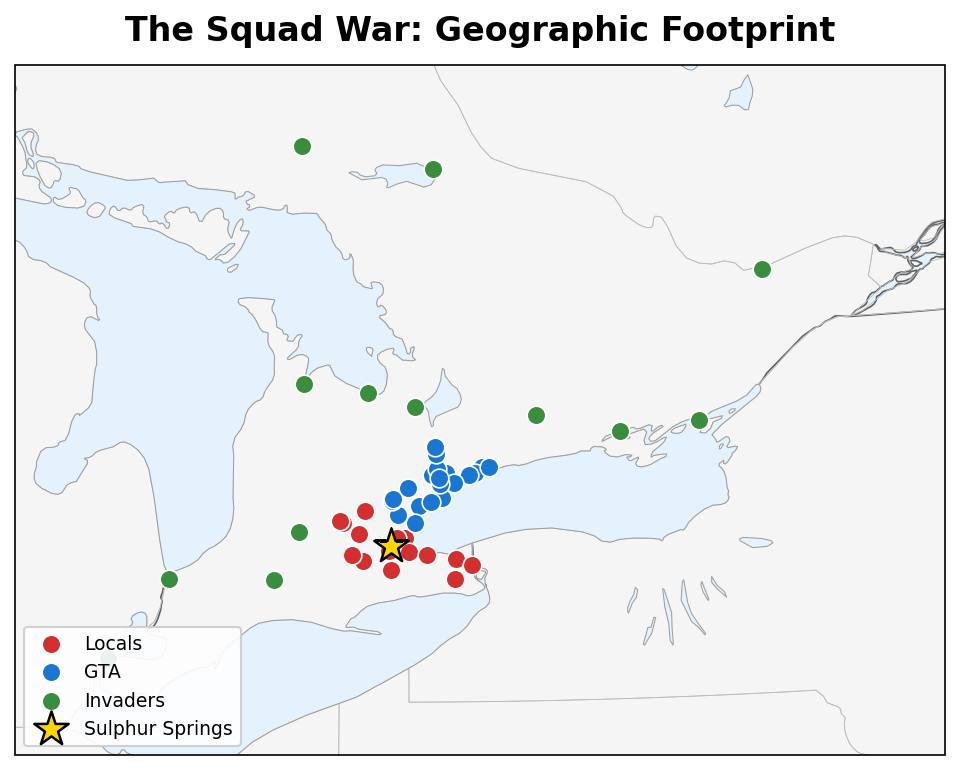
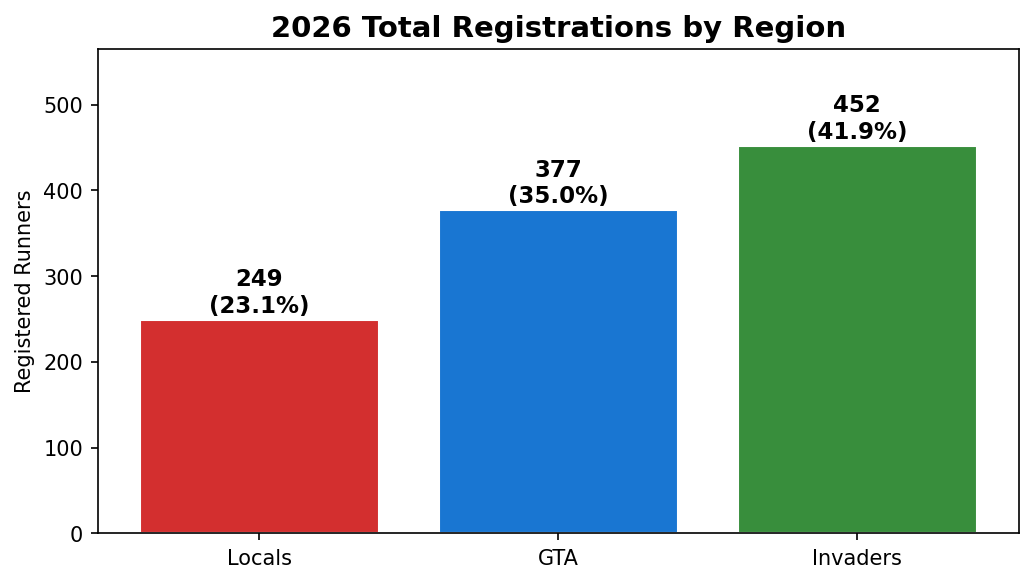
The entrant split by region is reasonably close with these groupings setting up a fair competition.
Then using cross-country scoring rules (lowest score wins, top 3 per gender per region count) across 2010–2025, we can see which teams historically have been the best.
Historical dominance
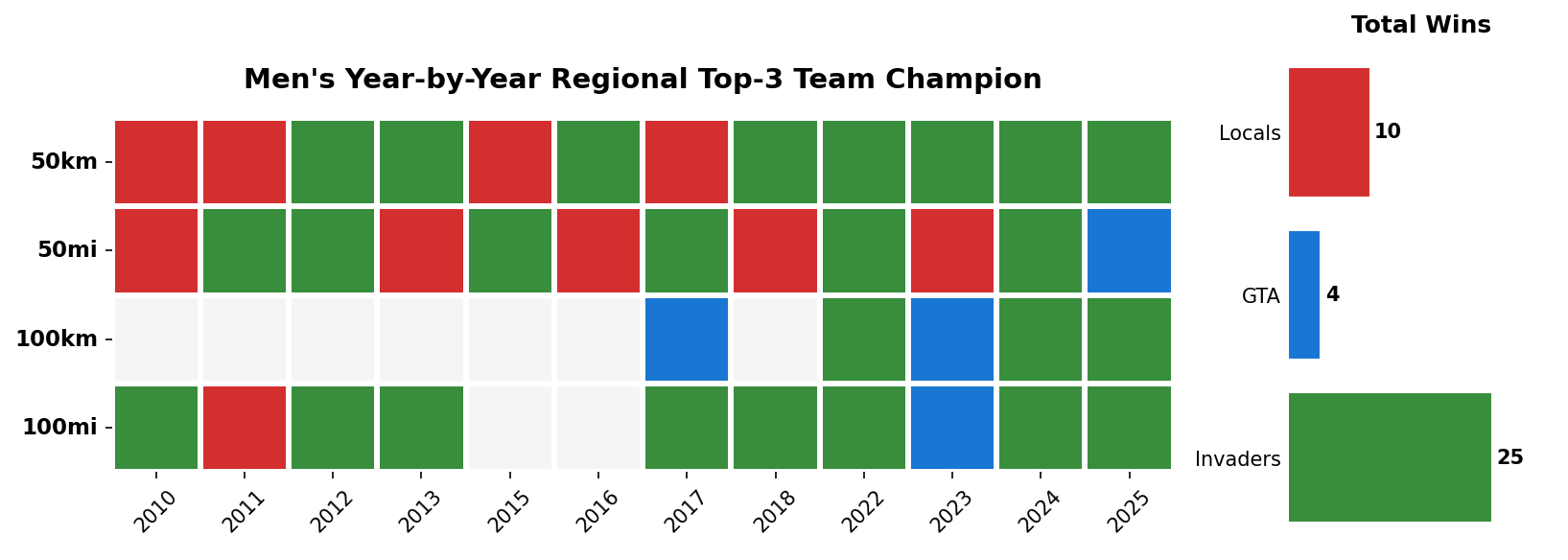
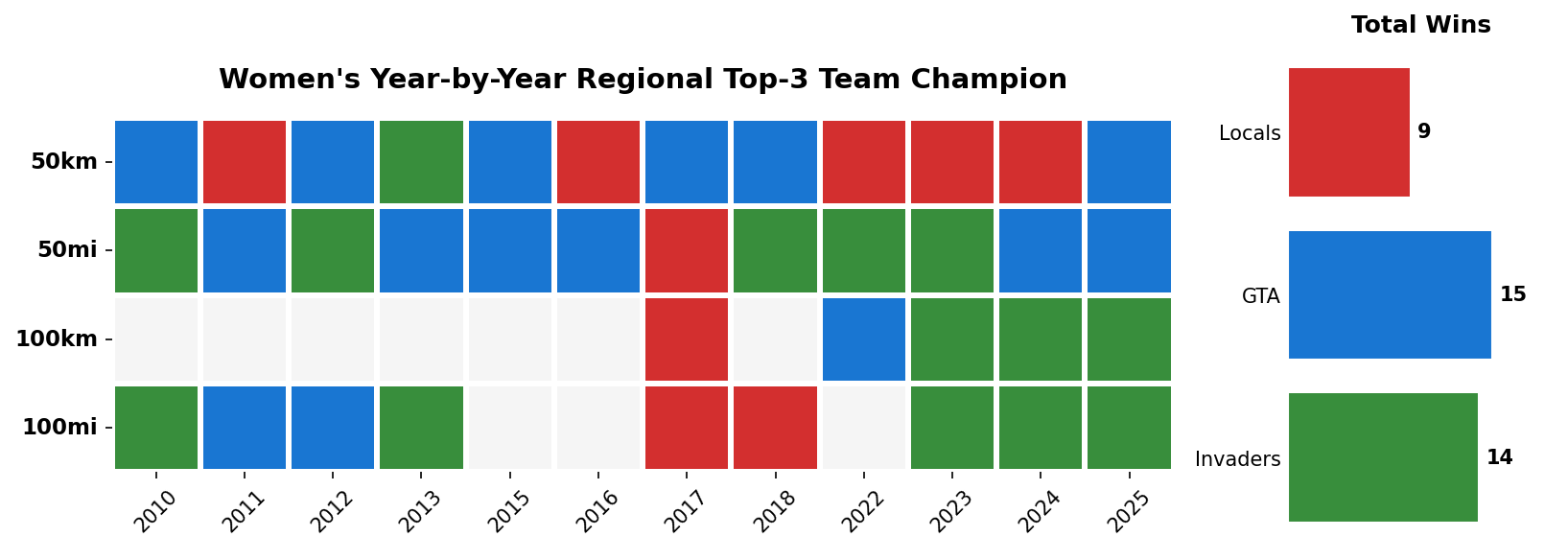
- Men: Invaders dominates the 100M (8 of 10 years); Locals and GTA trade wins in shorter distances.
- Women: GTA controls the 50k; Locals spike in the 100M when present; Invaders increasingly dominates longer races.
2026 Projected Team Scoring
Using the predicted finish times from a UTMB index based model, we can simulate the cross-country scoring for each region. Top 3 finishers per region score their predicted finishing position (1st = 1 point), lowest total wins.
| Distance | Men’s Winner | Score | Women’s Winner | Score |
|---|---|---|---|---|
| 50k | Locals | 8 pts | Locals | 10 pts |
| 50M | Locals | 6 pts | Locals | 10 pts |
| 100K | Invaders | 11 pts | Invaders | 8 pts |
| 100M | GTA | 6 pts | Invaders | 6 pts |
The historical pattern holds—but with a twist:
- Locals are projected to dominate the short distances for both genders, sweeping the men’s 50M, with closer battles in the women’s 50k and 50M.
- GTA is projected to score an almost-unprecedented 6 points in the Men’s 100M—a projected 1-2-3 finish from Sergio Ráez Villanueva, Edmund Heung, and Matt Tribe.
- Invaders continues to dominate the longer distances, led by Karen Holland, Star Hofer, and Caitlin McAuliffe (100K) and Molly Hurford, Joanne Moon, and Gesine Freund (100M).
Projected overall tally: Locals 4, GTA 1, Invaders 3. The locals’ home-course advantage pays off and reclaims the “championship” after a long drought.
Predicted Top 10 Finishers
To make the team prediction and to help drive the storylines I put together some predictions for the times and placings for each ultra. As we say in the modelling world, all models are wrong, but some are useful. I hope anyone that sees themselves on this list feels inspired to beat the prediction. It will be interesting to see how different the final results are to these predictions to see who had outstanding days.
To remove my own biases and scale this effort, every prediction is built from three signals, blended together based on how much we trust each one:
-
UTMB Performance Index — A global fitness score maintained by UTMB. I’ve trained a regression model on 3,324 historical index-to-finish-time pairs from Sulphur Springs (2010–2025) to translate each runner’s index into a predicted speed on this specific course. Runners without an official index are marked with
-; those with a proxy score derived from external race benchmarks are marked with*. -
Past Sulphur Springs results — Nothing predicts Sulphur like Sulphur. If a runner has raced this exact distance here within the past two years, that result is treated as the strongest signal. If the index suggests they should be slower than what they actually ran, we ignore the index entirely. If the index suggests they should be faster, we weight it heavily (70%) but keep their Sulphur time in the mix (30%) as insurance against a bad day. Older results are still used, but receive a 2% per-year slowdown penalty after a 3-year grace window.
-
Distance crossover scaling — For runners stepping up or down (e.g., a 50k runner entering the 100K), we scale their past time using Riegel’s ultrarunning fatigue formula, which applies an exponential penalty as distances increase.
For strong runners I’ve recognized in the startlist that don’t have a UTMB index, or a result at Sulphur Springs, I’ve assigned them a proxy UTMB index based on their known results in other races. For cases like Sergio in the 100M, I’ve taken people he’s run against in other races that have a UTMB index and assigned him a score based on how closely he’s finished relative to them.
100 Mile Trail Race
Men’s Field
Men’s Course Record: Paul Vanoostveen, 14:38:23 (2025)
| Rank | Athlete | Predicted Time | UTMB Index | Ultra Signup Score | Sulphur Springs History |
|---|---|---|---|---|---|
| 1 | Sergio Ráez Villanueva | 13:55:13 | 838.0* | - | - |
| 2 | Edmund Heung | 16:09:06 | - | 84.69 | 50mi (2023): 2nd in 7:38:27 |
| 3 | Matt Tribe | 16:29:57 | 693.0 | 79.36 | 100km (2023): 2nd in 9:23:34 |
| 4 | Elias Kibreab | 16:42:46 | 700.0 | 93.85 | 100km (2025): 3rd in 8:47:58 |
| 5 | Owen Lane | 17:27:14 | 665.0* | 85.0 | - |
| 6 | John Cole | 17:37:04 | 610.0 | 70.84 | 100mi (2025): 3rd in 17:37:04 |
| 7 | Ryan Flint | 18:16:58 | 636.0 | 88.8 | 100mi (2025): 4th in 18:24:26 |
| 8 | Eugenio Parra | 18:23:55 | 630.0 | 94.52 | - |
| 9 | Nicolas Cazelais | 18:45:36 | - | 68.3 | 50km (2023): 20th in 5:18:30 |
| 10 | Juan Zorrilla | 18:59:50 | 562.0 | 100.0 | 50mi (2025): 1st in 7:36:46 |
Women’s Field
Women’s Course Record: Amanda Nelson, 17:18:58 (2024)
| Rank | Athlete | Predicted Time | UTMB Index | Ultra Signup Score | Sulphur Springs History |
|---|---|---|---|---|---|
| 1 | Molly Hurford | 17:22:53 | 617.0 | 97.56 | 100mi (2025): 1st in 17:22:53 |
| 2 | Joanne Moon | 22:28:48 | 487.0 | 87.86 | 100mi (2025): 8th in 22:28:48 |
| 3 | Gesine Freund | 22:59:49 | 463.0 | 76.39 | 100km (2025): 10th in 12:56:32 |
| 4 | Esther Hagerman | 23:09:44 | 471.0 | 82.43 | 50km (2022): 11th in 5:23:17 |
| 5 | Bethany McRae | 23:47:33 | - | 74.67 | 100km (2023): 11th in 15:41:34 |
| 6 | Jessica Lee | 23:51:39 | 478.0 | 68.52 | - |
| 7 | Val Bauman | 24:44:00 | 434.0 | 77.56 | 100km (2025): 16th in 13:16:00 |
| 8 | Saskia Mattern | 24:45:00 | 433.0 | 72.04 | 100km (2025): 15th in 13:13:58 |
| 9 | Adrienne Kemp | 25:17:02 | 415.0 | 0.0 | 50km (2025): 39th in 6:08:19 |
| 10 | Ashley Sametz | 26:03:46 | 443.0 | 73.78 | 100km (2025): 11th in 13:01:57 |
100K Trail Race
Men’s Field
Men’s Course Record: Robert Brouillette, 8:07:22 (2025)
| Rank | Athlete | Predicted Time | UTMB Index | Ultra Signup Score | Sulphur Springs History |
|---|---|---|---|---|---|
| 1 | Brian Putre | 09:16:55 | 617.0 | 74.97 | 100km (2025): 4th in 9:16:55 |
| 2 | Liam Walke | 09:35:41 | 635.0 | 78.55 | 50km (2018): 7th in 4:16:27 |
| 3 | Cullen Price | 09:46:01 | 599.0 | 80.29 | 50km (2025): 5th in 4:12:53 |
| 4 | Ryan Niclasen | 09:47:43 | 640.0 | 89.81 | 100mi (2025): 2nd in 16:47:43 |
| 5 | Danny Tresise | 10:07:22 | 633.0 | 88.89 | 100mi (2025): 6th in 19:22:12 |
| 6 | Jordan Bierema | 10:10:12 | 589.0 | 89.07 | 100km (2025): 26th in 11:40:11 |
| 7 | Perry Curiston | 10:30:41 | 545.0 | 71.53 | 100km (2025): 8th in 10:30:41 |
| 8 | James Orr | 10:38:42 | 570.0 | 58.15 | 50M (2024): 3rd in 8:14:31 |
| 9 | Lawrence Warriner | 10:49:44 | 529.0 | 75.72 | 100km (2025): 11th in 10:49:44 |
| 10 | Tyler Chacra | 10:53:22 | 525.0 | 91.36 | 100km (2025): 12th in 10:53:22 |
Women’s Field
Women’s Course Record: Karen Holland, 9:55:14 (2025)
| Rank | Athlete | Predicted Time | UTMB Index | Ultra Signup Score | Sulphur Springs History |
|---|---|---|---|---|---|
| 1 | Karen Holland | 09:43:09 | 637.0 | 88.29 | 100km (2025): 1st in 9:55:14 |
| 2 | Star Hofer | 11:43:05 | 528.0 | 78.57 | 100km (2025): 7th in 11:59:56 |
| 3 | Caitlin McAuliffe | 12:11:23 | - | 75.48 | 50km (2022): 16th in 5:39:11 |
| 4 | Kirsten Clement | 12:29:45 | 469.0 | 78.73 | 50km (2025): 10th in 5:26:07 |
| 5 | Vicki Mayberry | 12:58:57 | 471.0 | 72.0 | - |
| 6 | Trina Boisvenue | 13:13:22 | 468.0 | 72.72 | 100km (2025): 19th in 13:35:31 |
| 7 | Donna Dowsett | 13:39:45 | - | 74.24 | 50km (2018): 18th in 5:52:31 |
| 8 | Linda Trinh | 13:49:44 | 430.0 | 76.74 | 100km (2025): 21st in 13:49:44 |
| 9 | Susan Munn | 14:05:19 | 408.0 | 70.84 | 100km (2025): 23rd in 14:05:19 |
| 10 | Niki Lanz | 14:18:03 | 409.0 | 68.67 | 50km (2025): 45th in 6:13:14 |
50 Mile Trail Race
Men’s Field
Men’s Course Record: Gabriel Miller, 6:28:06 (2023)
| Rank | Athlete | Predicted Time | UTMB Index | Ultra Signup Score | Sulphur Springs History |
|---|---|---|---|---|---|
| 1 | Will Gilmet | 08:03:38 | 583.0 | 93.51 | 50km (2025): 8th in 4:20:36 |
| 2 | Travis Marks | 08:37:56 | 524.0 | 70.21 | 50km (2025): 15th in 4:52:12 |
| 3 | Eric Tiedje | 08:57:51 | 520.0 | 71.13 | - |
| 4 | Andrew Douglas | 08:58:58 | 533.0 | 91.28 | 100km (2024): 10th in 11:25:37 |
| 5 | Brian Gauthier | 09:13:18 | 523.0 | 59.84 | 50km (2025): 58th in 5:51:31 |
| 6 | Ken Akune | 09:27:55 | 476.0 | 68.38 | 50km (2025): 33rd in 5:18:20 |
| 7 | Evan Johnston | 09:30:17 | 474.0 | 63.54 | 50km (2025): 34th in 5:19:38 |
| 8 | Isaac Herrera | 10:22:20 | 436.0 | 55.59 | 50km (2025): 59th in 5:52:01 |
| 9 | Allan Williams | 10:26:54 | 435.0 | 69.57 | 50km (2025): 93rd in 6:20:50 |
| 10 | Norm Stephen | 10:31:24 | 427.0 | 70.22 | 50M (2019): 45th in 11:07:06 |
Women’s Field
Women’s Course Record: Julie Hamulecki, 7:08:03 (2024)
| Rank | Athlete | Predicted Time | UTMB Index | Ultra Signup Score | Sulphur Springs History |
|---|---|---|---|---|---|
| 1 | Angela Pasceri | 09:59:56 | 458.0 | 70.65 | 100km (2025): 20th in 13:39:49 |
| 2 | Jessica Shao | 10:04:19 | 449.0 | 74.34 | 50km (2025): 15th in 5:41:21 |
| 3 | Jada Carr | 10:36:06 | 439.0 | 69.32 | - |
| 4 | Paulina Karwowska | 10:55:37 | - | 70.12 | 50km (2022): 35th in 6:24:28 |
| 5 | Shirin Niroomand | 10:59:44 | 409.0 | 64.3 | 50km (2025): 41st in 6:11:06 |
| 6 | Dylan Magner | 11:07:55 | 405.0 | 67.87 | 50km (2025): 47th in 6:17:55 |
| 7 | Jisun Hahn | 11:12:51 | 413.0 | 68.77 | 50km (2025): 56th in 6:40:34 |
| 8 | Edda Oviedo | 11:36:27 | 401.0 | 61.98 | 50km (2025): 65th in 6:59:23 |
| 9 | Yi Xiao | 12:12:44 | 367.0 | 61.51 | 50km (2025): 62nd in 6:53:07 |
| 10 | Erica Swirsky | 12:19:42 | 376.0 | 100.0 | 100km (2024): 23rd in 15:34:00 |
50k Trail Race
Men’s Field
Men’s Course Record: Alex Forte, 3:23:02 (2025)
| Rank | Athlete | Predicted Time | UTMB Index | Ultra Signup Score | Sulphur Springs History |
|---|---|---|---|---|---|
| 1 | Dylan Pust | 03:29:05 | 814.0 | 94.78 | 100km (2024): 2nd in 8:29:04 |
| 2 | Matthew Farquharson | 03:37:01 | 784.0 | 91.68 | 50km (2023): 2nd in 3:46:05 |
| 3 | Jeremy Walsh | 03:52:19 | 733.0 | 86.19 | 50km (2022): 7th in 4:05:18 |
| 4 | Jonathan Gray | 03:58:24 | 679.0* | 90.26 | - |
| 5 | Taylor Reid | 04:10:38 | 644.0* | 44.24 | - |
| 6 | Eric Ashby | 04:31:23 | 558.0 | 73.64 | 50km (2025): 11th in 4:31:23 |
| 7 | Andriy Yatsynych | 04:31:28 | 559.0 | 65.65 | 50km (2024): 10th in 4:31:28 |
| 8 | Nick Ridpath | 04:39:19 | 574.0 | 81.11 | - |
| 9 | Wayne Westby | 04:40:41 | 571.0 | 78.05 | - |
| 10 | Andrew Norman | 04:42:33 | 567.0 | 61.07 | - |
Women’s Field
Women’s Course Record: Tanis Bolton, 4:10:55 (2023)
| Rank | Athlete | Predicted Time | UTMB Index | Ultra Signup Score | Sulphur Springs History |
|---|---|---|---|---|---|
| 1 | Bridget Cobham | 04:55:45 | 512.0 | 95.39 | 50km (2024): 2nd in 4:55:45 |
| 2 | Bethany McChesney | 04:58:28 | 541.0 | 80.66 | - |
| 3 | Ingrid Perugachi | 05:05:49 | 527.0 | 83.21 | - |
| 4 | Dorothy Apedaile | 05:07:37 | 516.0 | 81.77 | 50km (2025): 7th in 5:07:37 |
| 5 | Jamie McGill Worsley | 05:39:23 | 471.0 | 75.89 | 50km (2025): 13th in 5:39:34 |
| 6 | Leanne MacFayden | 05:39:58 | 470.0 | 74.09 | - |
| 7 | Tamara Robb | 05:50:58 | 454.0 | 71.73 | - |
| 8 | Benita Whyte | 05:53:07 | 451.0 | 68.82 | - |
| 9 | Maria Musselman | 05:53:25 | 433.0 | 72.54 | 50km (2025): 27th in 5:53:25 |
| 10 | Rina Atienza | 05:54:57 | 476.0 | 73.08 | 50M (2025): 1st in 9:00:58 |
* Indicates a proxy UTMB index.
The Western States Equation
Sulphur Springs is one of the few races in Canada that can earn its finishers a lottery ticket for the Western States 100-Mile Endurance Run. To get a ticket, 100 Mile runners need to finish in 30 hours, and 100k must finish in 18 hours. In order to become a qualifying race, Sulphur Springs needed 100 finishers in the 100M and/or 100k distances. Doing a quick projection for 2026, the finishers will be well over the threshold for both distances.
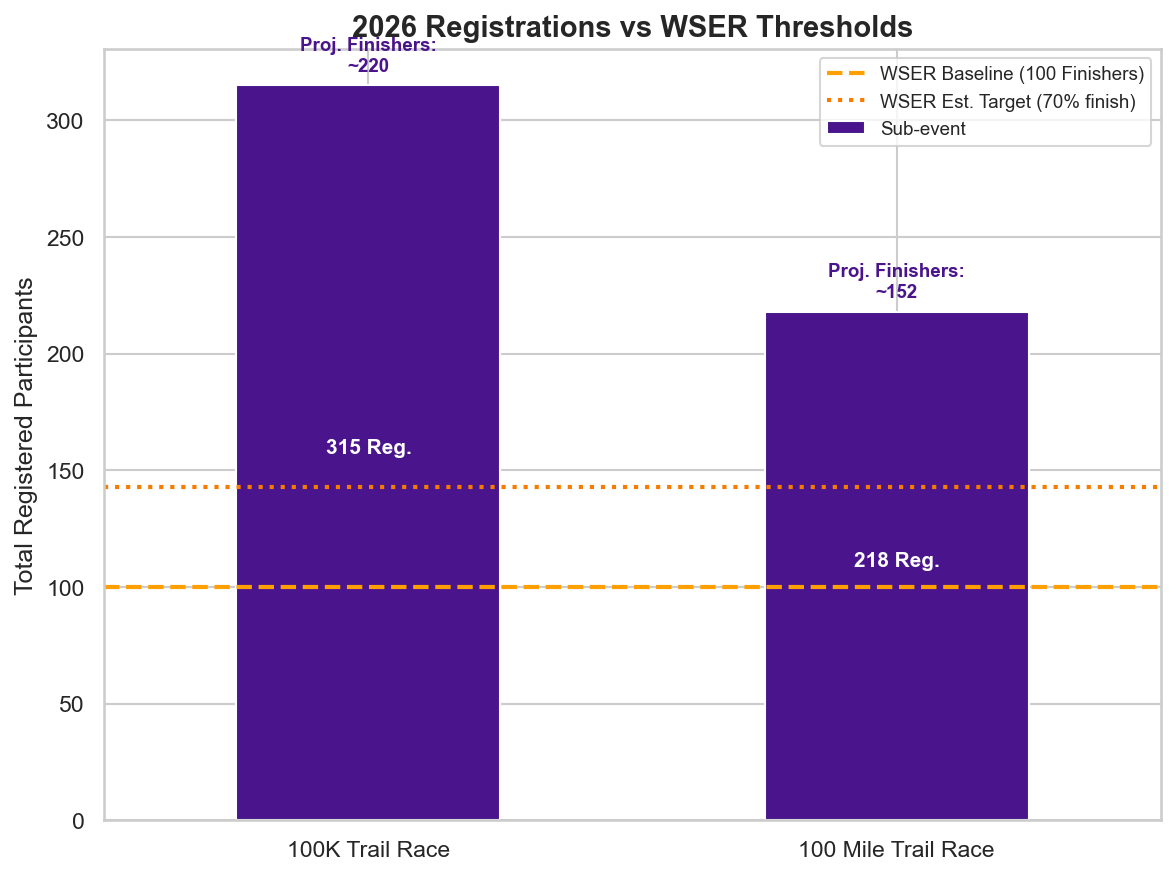
Registration has gone from 269 entrants (226 who finished) in the 100K and 169 entrants (96 who finished) in the 100M in 2025, up to 315 and 218 respectively for 2026. Suffice to say the Western States qualifier is all but guaranteed for this year.
Geographical Catchment Flow
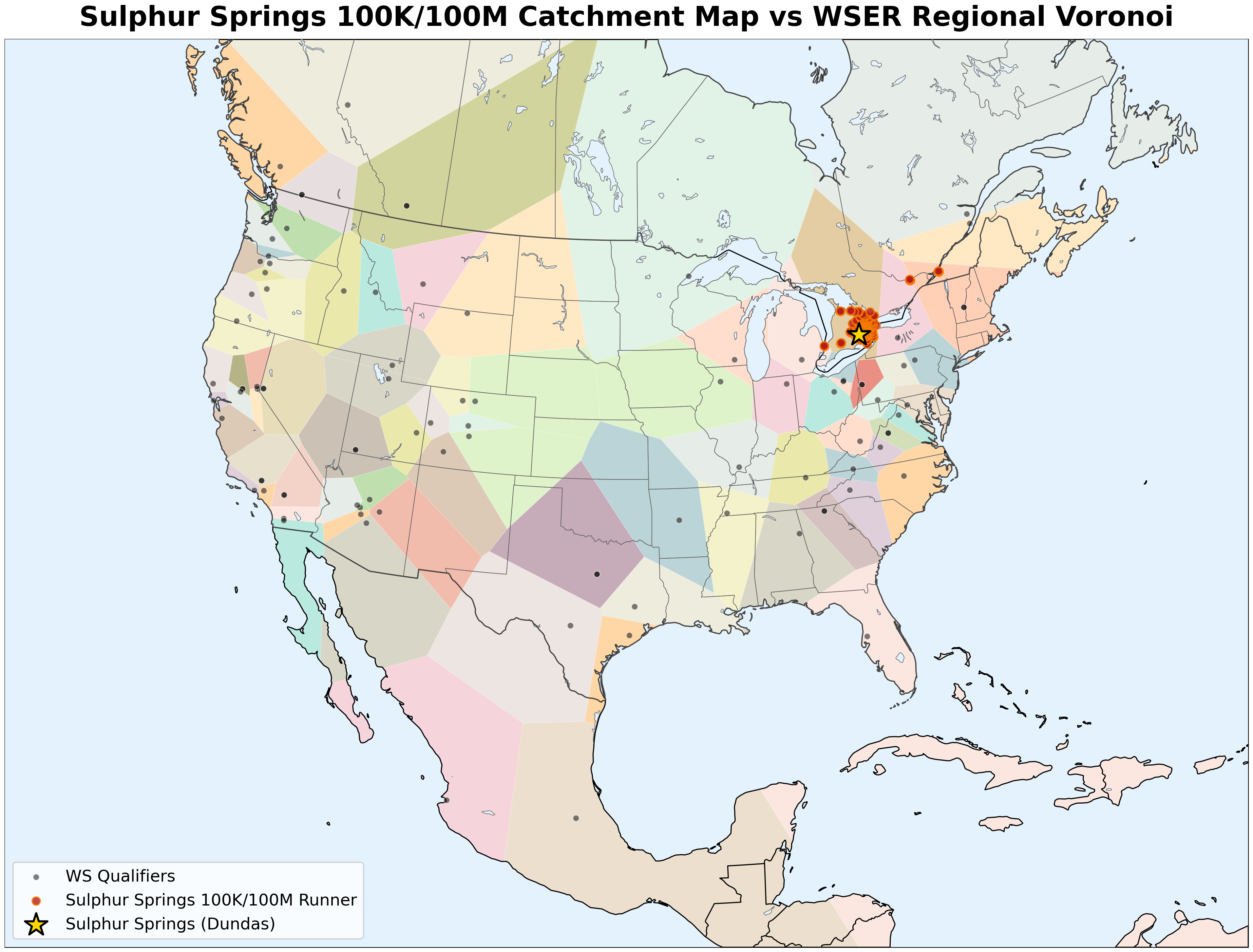
In a previous post I mapped out the geographical catchment of the Western States Endurance Run qualifier races. One of the interesting findings was the recent inclusion of Sulphur Springs, which serves the massive population of Ontario. We can see that 2026 the locals are again showing up in high numbers to get their ticket to the big dance.
Mapping 100K and 100M starters against the Western States North American catchment highlights the importance of this race as the only qualifier in Ontario and one of only a handful in Canada.
The Legendary Returners
For many athletes, Sulphur Springs is a yearly tradition. By examining lifetime finishes, I’ve identified a group of “Sulphur Hall of Famers”.
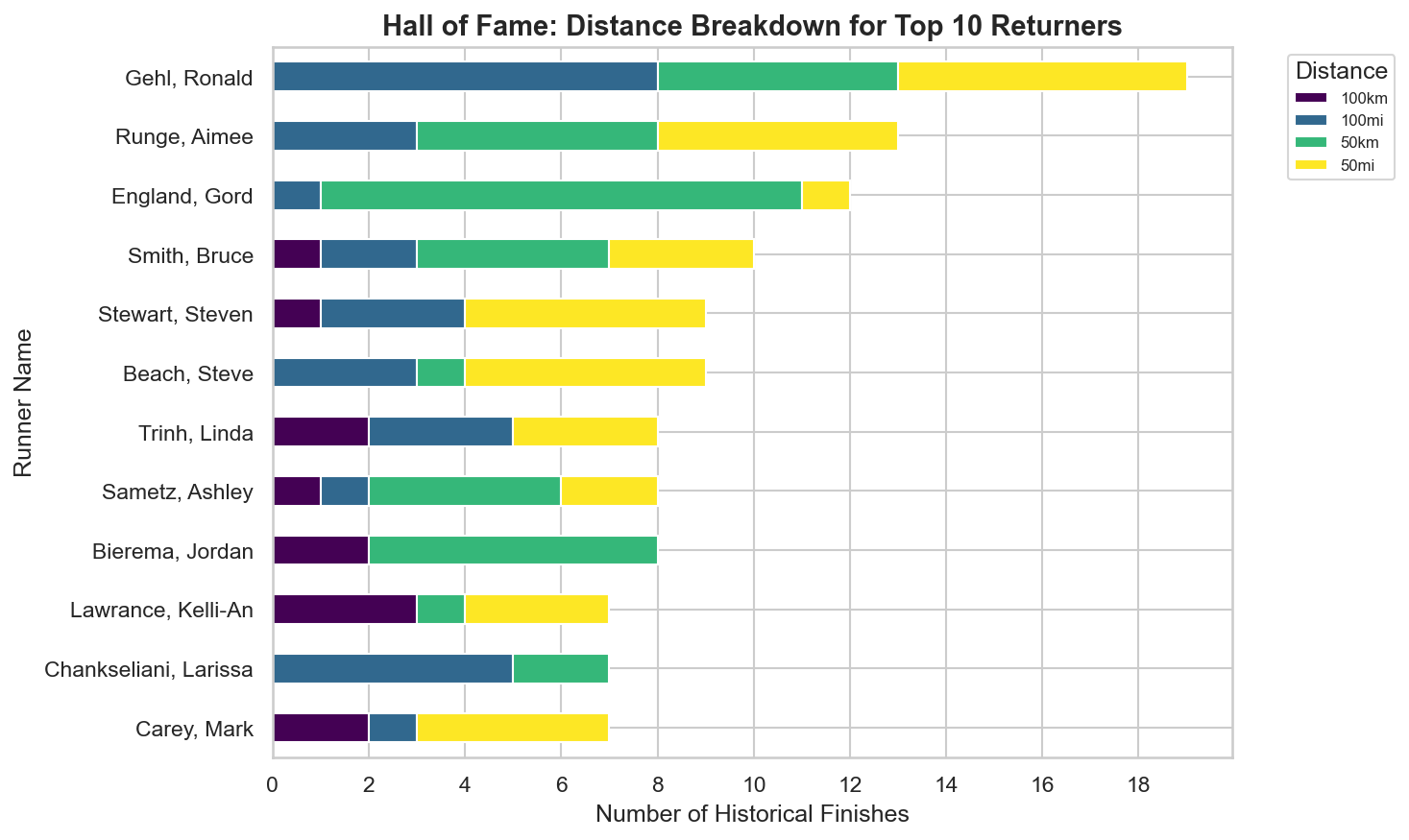
I only planned on writing this post about the elites, but seeing that Ronald Gehl has run 19 ultras at Sulphur Springs over the past 30 years is amazing to me. My finger got tired from scrolling his results. He’s been awarded the Norm Patenaude Award 29 times for finishing 7 or more Ontario ultras a year. At the age of 79 he’s signed up again this year in the 50 mile to continue a 4 year streak at that distance. He’s one year shy of being the oldest Sulphur finisher after Hans Maier who ran the 50k in 2019 as an 80 year old. Long after the winners are done, he’s still out there—that’s the heart of Sulphur Springs.